The Configurations Lab
A research practice studying what humans, organizations, and AI become together, and the practices, capacities, and identities those configurations produce.
Reality has gotten harder to read on its own. The technologies people use, the organizations they work inside, and the contexts they live in are reshaping each other faster than any single field can keep up. The questions that matter most now live in the entanglement, not inside any one discipline. The Configurations Lab studies that entanglement directly. Our work draws on three research perspectives. Design and HCI examine how humans and technology encounter each other. Science and technology studies looks at what actually gets enacted between people and things. Organizational theory tracks how institutions shift under pressure. Systems design is the practice that holds these perspectives together, so we can read across them rather than choose between them. The goal is to make sense of what is happening now, and to make visible what could happen next.
We are hiring · Advisory / engineering Senior Go engineers, remote from Colombia and Latin America. Two open contractor roles in integration platforms and identity & access, for teams in insurance and financial services. See engagements ↓Forty years of human–technology research, and the moment we are now in.
The lab works from a specific reading of where the field has arrived. Across roughly four decades, from the first usability research in the 1980s, through the workplace-ethnography turn of the 1990s, through the experience-and-meaning turn of the 2000s, researchers have asked the same family of questions about people and technology, with a different unit of analysis each time. The current moment is different. AI does not interact with users. It joins configurations. The unit of analysis has shifted again, and the practical implications are only beginning to be worked out.
Each era took roughly fifteen years to consolidate. Each one carried a characteristic research method, produced a characteristic outcome, and operated on a set of assumptions that the next era had to break. The strip below maps the four eras at a glance. The expandable section beneath it goes into the academic background for readers who want the depth.
What matters in practical terms is this: the questions organizations and practitioners are now facing, what AI is doing to professional work, to organizational form, to how decisions get made, do not sit cleanly inside any one of the prior eras' frameworks. The lab studies these questions on their own terms, with the methods and vocabulary the current moment requires.
The Four Eras of HCI. A complete visualization.
Forty years of HCI mapped across the dimensions that matter: dominant paradigm, unit of study, canonical method, design stance, the HCI outcome each era produced, the persuasive-technology parallel running beside it, the organizational framing of the same period, and the STS analytic object. Built as a teaching artifact, and as a publishable figure.
Three lenses, read together through the practice of systems design.
The lab studies human–AI configurations through three theoretical lenses: human–computer interaction, science and technology studies, and organizational theory. Each lens has its own privileged phenomenon, its own validated instruments, and its own partial view. The practice of systems design reads across all three. It is not a fourth lens, but the way the lab holds the lenses together without one absorbing the others.
Hover a lens to isolate its projection · hover the field to hold a single reading
Encounter reading
picks up: closures · encounters · the moment of synergy
Where three actors close. Encounters become readable as the moment a configuration emerges and briefly holds.
Network reading
picks up: actors · relations · apparatus
Who is doing what to whom. How the apparatus rearranges who counts as an actor. Connections form and dissolve as proximities shift.
Jurisdictional reading
picks up: jurisdictions · authority · domains
Where authority lives. Which institutional ground the actors touch. The grid is always there; it lights up where action is happening.
Adoption is one reading. Not the configuration.
No map is the territory · each shows what its projection enables it to show
What the lab has already produced. Published research on AI in professional practice.
The lab's empirical foundation is the Design Identity study, a multi-country survey on how AI is reshaping professional design practice across three theoretical lenses: design studies, HCI, and STS. The dashboard below presents the cross-sector findings. The accompanying paper has been accepted by Base Diseño e Innovación and is in the editorial process.
Design Identity. AI in design practice, read through three lenses.
An interactive dashboard presenting the findings of a cross-sector survey of 217 design practitioners across 43 countries, conducted bilingually in English and Spanish. The study uses three theoretical lenses, design studies, HCI, and STS, to ask how AI is changing what designers do, how they think, and what design means. Eight tabs surface the findings, six archetypes, the Latin-America view, the bilingual lens, twenty-nine documented anomalies, and the framework's so-what.
The Three Lenses Executive Dashboard. Open for collaboration.
The lab's organizational-scale instrument is in development. The Three Lenses Executive Dashboard applies the lab's three-lens framework (HCI, STS, and Organizational) to organizational AI adoption. It surfaces the practice changes, ontological shifts, and institutional logic moves happening simultaneously inside organizations. The instrument is built to be populated with guest researcher data across sectors, and we are actively inviting collaborations.
The 3×3 Executive Dashboard. A diagnostic X-ray of an AI-era organization.
A diagnostic instrument that produces what we call an X-ray of an organization's current AI configuration. It captures a snapshot of an ephemeral arrangement, surfacing what is being enacted at the moment of measurement. Built around nine concepts, three per lens, each anchored in established literature: agency attribution, inscription response, and network reconfiguration (STS); algorithmic isomorphism, ambidexterity, and institutional logic shift (Organizational); interaction intelligence, metacognitive capacity, and tool ecosystem (HCI).
Two evolutions the lab is naming. One in persuasion, one in systems.
The lab makes two theoretical moves, each naming a fourth-wave successor to a framework the field still leans on. The first reworks BJ Fogg's Persuasive Technology (2003) and its triad of Tool, Medium, and Social Actor. AI breaks that triad by dissolving the sender–receiver model persuasion runs on, so the lab proposes Constitutive Technology, with a new triad: Practice, Cognition, and Identity. The second traces systems design across four eras and names the one the lab already works in, Entangled Systems Design, the wave-four successor to complex adaptive systems. One move is about what technology does to people. The other is about how the lab holds its three lenses together.
From Persuasion to Constitution. Fogg's triad meets the fourth wave.
A full theoretical visualization mapping Fogg's wave-three triad (Tool, Medium, Social Actor) against its wave-four successor (Practice, Cognition, Identity). Each Fogg category is paired with what AI dissolves in it, what the wave-four replacement names, and the full academic background for each. Structured as a publishable figure for the lab's forthcoming theoretical paper.
From CAS to configuration. Naming the fourth era of systems design.
A four-era map of systems design, from hard systems and first-order cybernetics to the configurational work of the present. It places complex adaptive systems as the third era rather than the fourth, then names the era the lab already works in: Entangled Systems Design, the wave-four extension of the Cross–Buchanan–Owen tradition through Suchman, Barad, Forlano, and Frauenberger. Offered as ongoing research, a working proposal for the lab's integrating practice.
Configurational Probes. The lab's signature method.
Every era of HCI has had its signature probe. Era 1's Think-Aloud surfaced cognition. Era 2's Contextual Inquiry surfaced situated work. Era 3's Cultural Probes (Gaver, Dunne, and Pacenti 1999) surfaced experience and meaning. The lab's Configurational Probes are the fourth-era successor: structured prompts that surface what gets enacted when humans, AI, and context configure together. The method is in active development. It extends the research director's prior work on provotypes and research-through-provocation into the wave-four configurational frame.
Probes for the fourth era. Structured visibility for configurations.
Configurational Probes are structured prompts deployed inside human–AI configurations to surface what those configurations are enacting, at the practice layer, the cognition layer, and the identity layer. The method inherits two things. From Gaver's cultural probes, it takes the commitment to evocative rather than measurement-only instruments. From the research director's earlier research-through-provocation work, it takes the use of designed provocations as research apparatus. The probes are the empirical instruments that produce the diagnostic X-rays the 3×3 framework reads.
Why Configurations.
The lab's name is also its argument. Configurations names the unit of analysis the lab works on, the concept that connects the three theoretical lenses, and the practical operationalization of entanglement, the fourth-wave HCI claim that humans, technologies, and contexts no longer hold still as separable entities. The plural matters. The lab studies configurations, in different sectors, at different scales, with different lenses brought to bear.
As the unit of analysis. Where third-wave research could take "the user" as a stable subject to study, fourth-wave conditions require a different unit. One that holds humans, technologies, and contexts together rather than separating them for analysis. The configuration is that unit. It names the arrangement of people, tools, AI, organizational scaffolding, and situated context that produces what we are now studying, without requiring us to pretend any one of them stands still while we examine the others.
As the operationalization of entanglement. "Entanglement" is the fourth-wave HCI term for what is happening (Frauenberger 2019), but as a concept it can stay abstract. Configurations makes it concrete and researchable. Every configuration is a specific entanglement, available for study at a specific moment, in a specific case. Where entanglement names the condition, configurations name what the condition produces, and what the lab makes visible.
As the lens-crossing concept. The lab arrived at Configurations after a structured naming exercise that ran across the lab's three lenses and the integrating practice of systems design. The exercise mapped how each tradition names the unit of analysis in the fourth-wave moment, and one concept appeared in every map. The plural, Configurations, not Configuration, names both the singular concept and the multiplicity of cases the lab studies.
How each lens names the wave-three → wave-four shift
↓
Wave 4: Configurational Identity
↓
Wave 4: Configurational Becoming
↓
Wave 4: Constitutive Configuration
↓
Wave 4: Configurational Design
The lab's research is directed by Jaime Rivera, PhD.
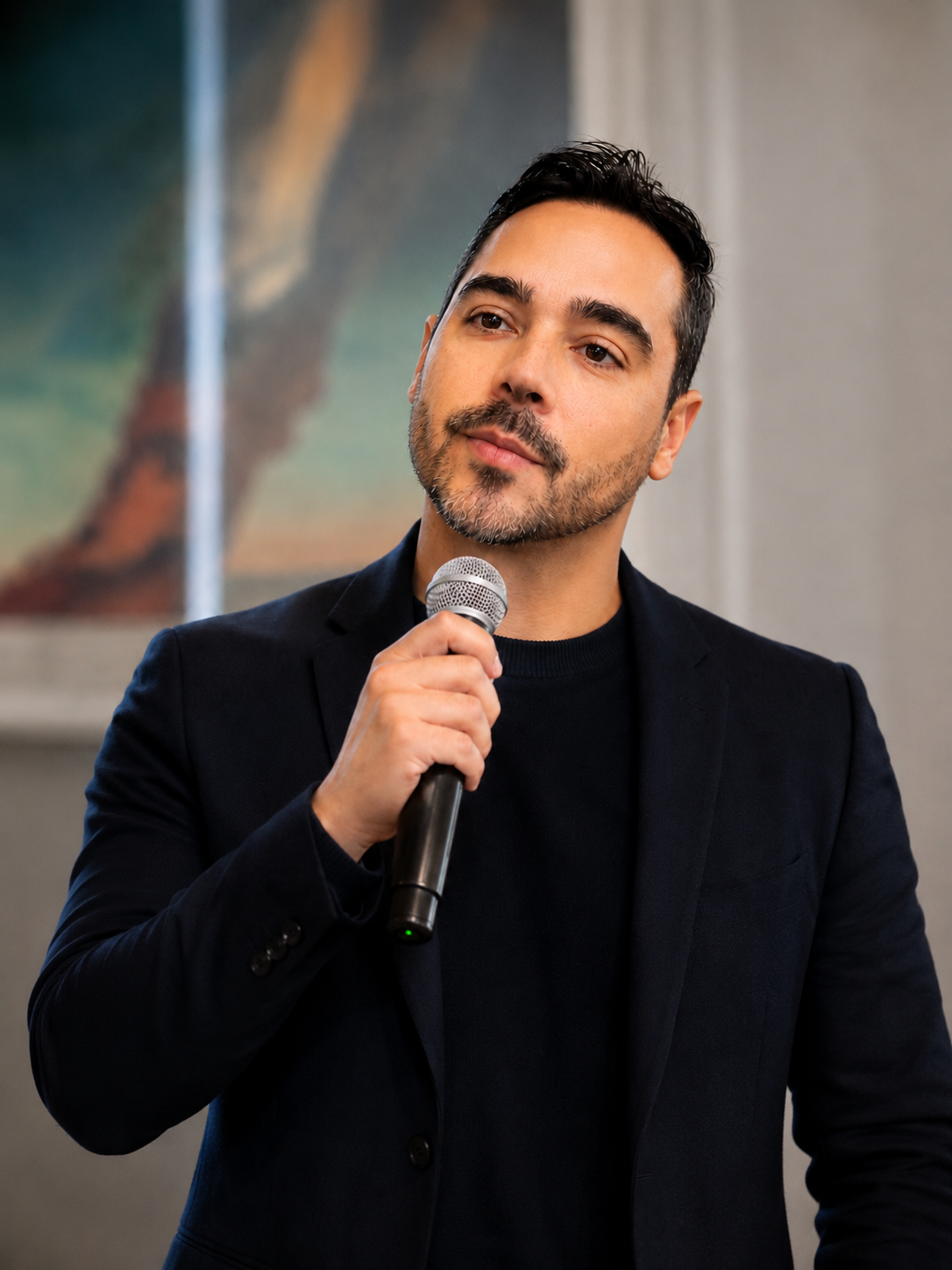
Jaime Rivera
Jaime Rivera is a UX researcher, design strategist, and educator whose work bridges academic research on human–technology configurations and industry practice in design strategy. He earned his PhD at the IIT Institute of Design with a dissertation on research-through-provocation, the methodological lineage that has now extended into the lab's Configurational Probes.
His earlier work on persuasive technologies, structured prototyping, and cooperative persuasion (Iconofacto 2015; Persuasive Technology Conference 2014) established the methodological foundation. His current work on AI in professional practice, including the Design Identity study (Rivera and Russi, accepted by Base Diseño e Innovación) and the 3×3 executive dashboard, extends that foundation into the wave-four moment. The lab is the institutional form of that ongoing research program.
In industry, he has worked across financial services, healthcare, retail, and industrial design, leading research and strategy engagements with Tier-1 consulting clients. The lab is built to maintain academic depth while engaging industry seriously. Both audiences read the same work.
Lab affiliations · independent and multi-institutional
Collaborate, or engage.
The Configurations Lab is built for research collaboration and for industry engagement, and we treat both with the same intellectual seriousness. Academic peers, doctoral and master's students, and research labs working on adjacent wave-four problems (entanglement HCI, posthuman design, organizational AI adoption, configurational STS) are invited to collaborate on the Design Identity dataset, the 3×3 dashboard, the Configurational Probes development, and forthcoming theoretical work including the Beyond Persuasion paper. Organizations can work with the lab through its advisory practice, which takes two forms: diagnostic engagements that use the lab's instruments on their own AI configurations, and engineering engagements that place senior engineers inside their product and engineering teams.
Collaborate on the research program.
Open to joint papers, guest-researcher partnerships on the 3×3 dataset, cross-institutional methodological development of Configurational Probes, and doctoral and master's thesis co-supervision in the wave-four space. The lab particularly welcomes collaborators whose work extends the entanglement HCI, posthuman design, and configurational STS lineage with empirical depth.
Open a collaboration inquiry →Engage the lab's diagnostics.
Open to structured engagement with organizations on the diagnostic visibility of their AI configurations, using the 3×3 executive dashboard, Configurational Probes, and the lab's three-lens framework. Engagements are scoped as research partnerships rather than consulting deliverables. The lab's commitment is to legibility, not transformation roadmaps.
Open an engagement inquiry →Engineering engagements.
Senior engineers who work with product and engineering teams at international insurance and financial services companies, on backend platforms, integration, and identity. The same commitment carries over from the research: understand the configuration before changing it. Senior engineering roles are currently open.
See the open roles →Research collaboration: jaime@theconfigurationslab.org
Advisory & careers: info@theconfigurationslab.org
Currently: Open to research collaboration & industry engagement
Languages: English · Spanish
Privacy: How we handle your data